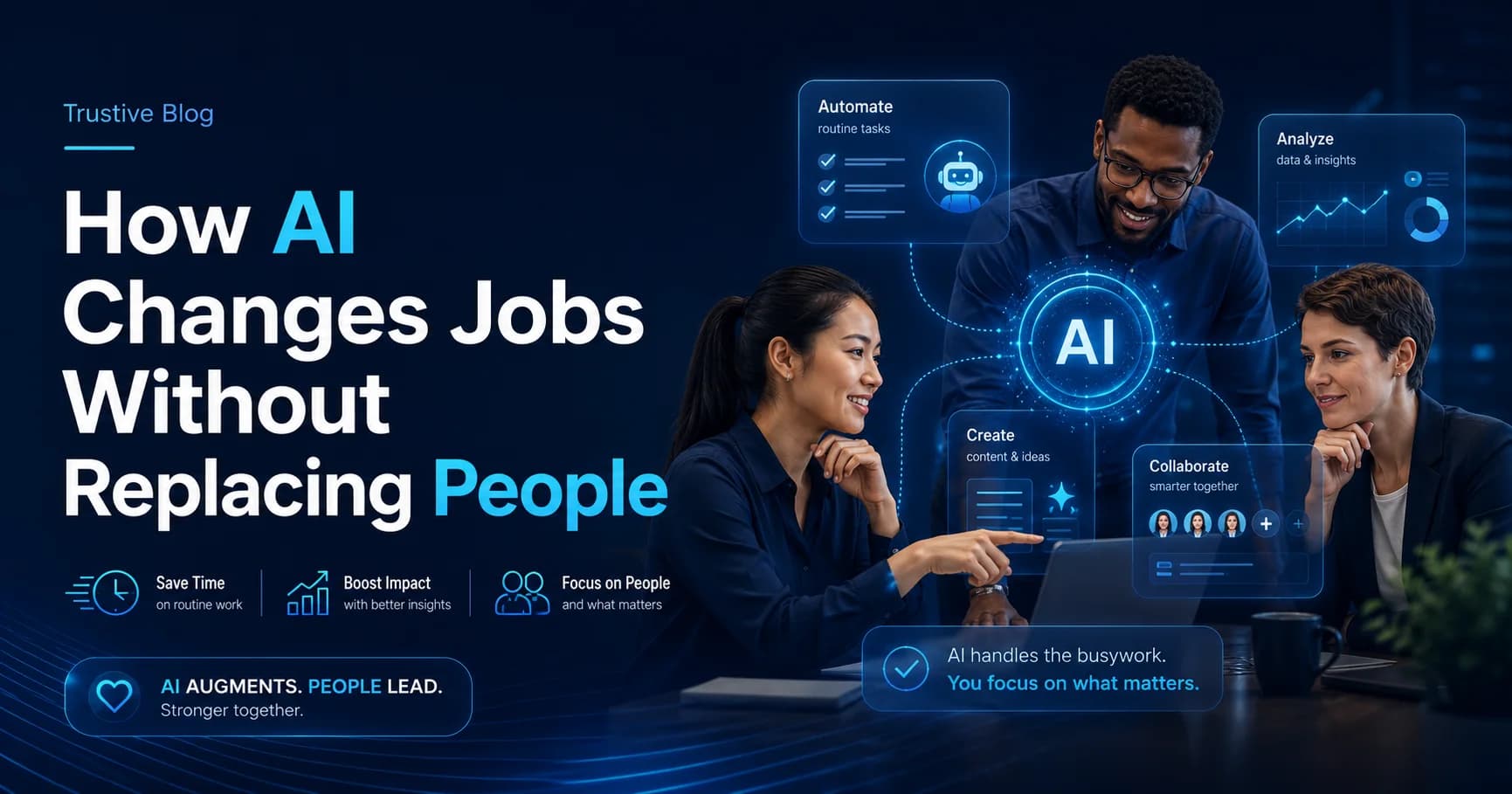
AI rarely replaces whole jobs — it replaces tasks. A practical look at task automation, job redesign, and how human-centered adoption protects people while improving productivity.
How AI Changes Jobs Without Replacing People — Trustive AI
When people ask whether AI will take their job, they are usually asking the
wrong question. The evidence so far points somewhere more specific: AI rarely
replaces whole jobs. It replaces tasks — and what happens next depends almost
entirely on choices employers make.
## Jobs are bundles of tasks
A customer-support role includes triaging tickets, writing responses, updating
records, escalating edge cases, and calming down angry customers. An AI system
might handle first-draft responses well, triage moderately well, and emotional
de-escalation not at all. The role survives; its composition shifts.
This is why blanket predictions about "jobs destroyed by AI" age so badly.
The unit of change is the task, and tasks recombine.
What changes first
Three patterns show up consistently in early adopters:
Drafting moves to AI, judgment stays human. First drafts of emails, code, reports and summaries are increasingly machine-generated, with people editing and approving.
Coordination shrinks. Status updates, meeting notes and handovers — the connective tissue of office work — compress dramatically.
Volume expectations rise. The same person is expected to handle more cases, more code, more content.
The third pattern is where wellbeing risk concentrates. If every saved hour is
immediately refilled with more work, employees experience AI as acceleration,
not relief.
The choice that matters: where does the saved time go?
[Human-centered adoption](/blog/trustive-explained-all-you-need-to-know) starts by [measuring honestly](/blog/measuring-time-saved-by-ai) — per task, per person —
how much time AI actually saves. Then it makes an explicit, visible decision
about the split. Organizations that return even part of that time to learning,
deep work or genuinely shorter workloads report better retention and less AI
resistance than those that silently raise quotas.
What employees can do
Inventory your own tasks and be honest about which are drafting vs judgment.
Build fluency with the tools now; the augmented version of your role is the durable one.
Ask your employer the direct question: where does the saved time go?
What employers can do
Measure saved time before setting new targets, not after.
Redesign roles deliberately instead of letting them drift.
Make the productivity split explicit — and share part of it with the people who generated it.
AI should give people more time. Whether it does is not a technical question.
It is a governance question — and it is answerable.
[+] Get the next analysis first
Loading signup form…
We send one thoughtful email at a time — no spam, no selling your data. Unsubscribe anytime. See the privacy policy.