Measuring Time Saved by AI - A Practical Framework — Trustive AI
Ask a team how much time AI saves them and you will get confident answers that
fall apart under one follow-up question: compared to what? Without a
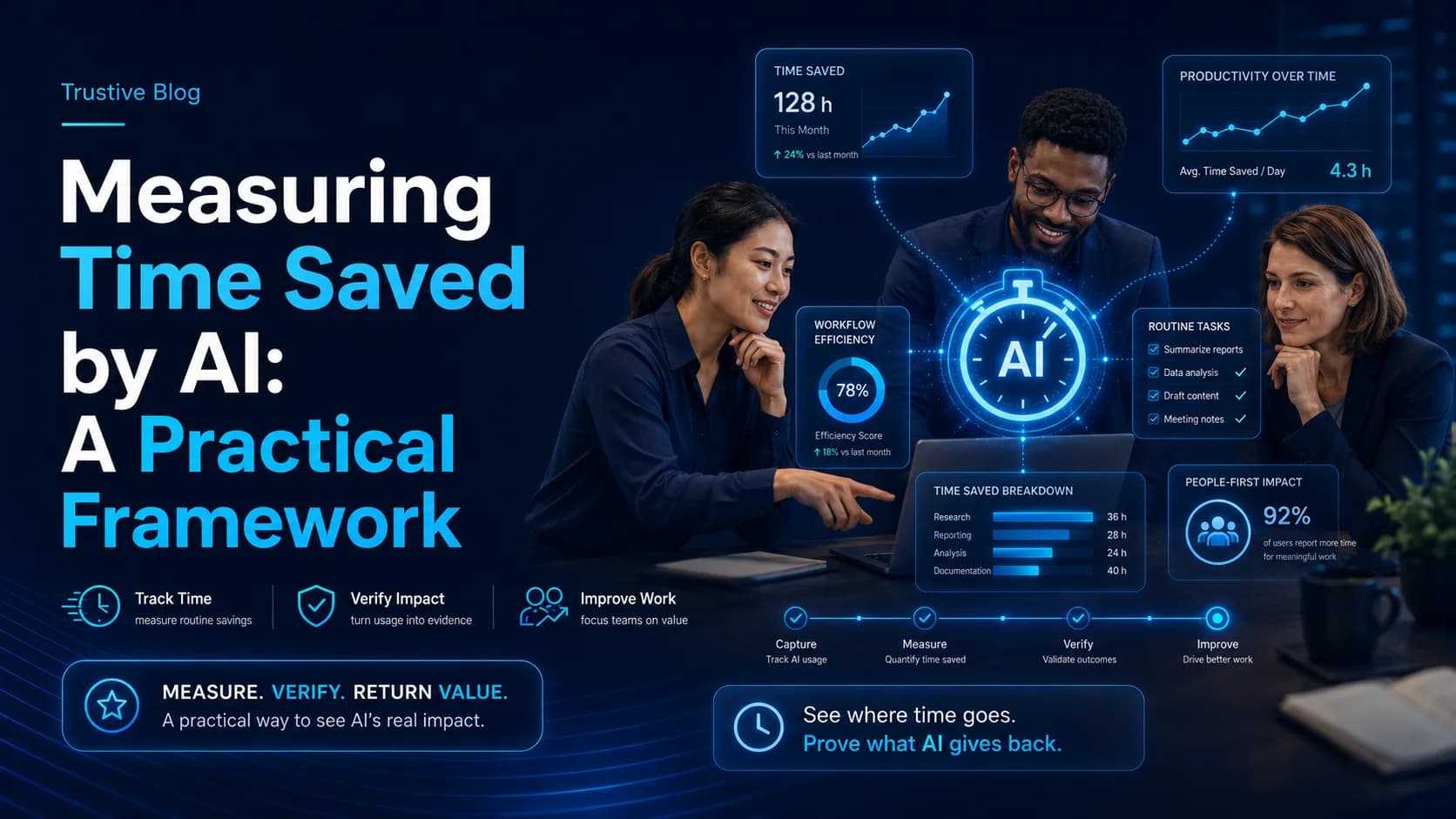
baseline, every AI productivity claim is a guess. Putting a real number behind it is the first step of the Trustive approach.
## Step 1: Pick tasks, not tools
Measure at the task level: "draft a customer proposal", "review a pull
request", "summarize a research call". Tool-level metrics ("hours in the AI
assistant") measure engagement, not value.
Choose 5–10 tasks that are frequent, bounded, and done by several people.
Step 2: Establish a baseline
For each task, capture how long it takes without AI assistance today. Use a
small sample — even 10 timed instances per task beats an estimate. Record the
variation, not just the average; task times are usually long-tailed.
Step 3: Measure the assisted workflow end-to-end
Include prompt time, review time, correction time, and rework caused by AI
errors. Net time saved = baseline − full assisted duration.
Step 4: Decide — visibly — where the time goes
Publish the split. For example: 50% to increased throughput, 25% to quality
and testing, 25% returned to employees as protected learning or focus time.
The exact ratio matters less than the fact that it is explicit and honored.
Metrics worth tracking
Metric
Why it matters
Net minutes saved per task instance
The core number, baseline-adjusted
Verification overhead ratio
Reveals when AI output quality is too low to pay off
Adoption rate per task
Low adoption with high savings = training gap
Returned-time delivery
Whether the promised human share actually happens
Vanity metrics to avoid
prompts sent or "AI interactions";
percentage of employees "using AI";
self-reported hours saved without baselines;
model benchmark scores presented as business impact.
Honest measurement is slower than a survey and vastly more useful. It is also
the foundation for trust: people support AI adoption when they can see the
gains are real — and see some of them coming back.
[+] Get the next analysis first
Loading signup form…
We send one thoughtful email at a time — no spam, no selling your data. Unsubscribe anytime. See the privacy policy.