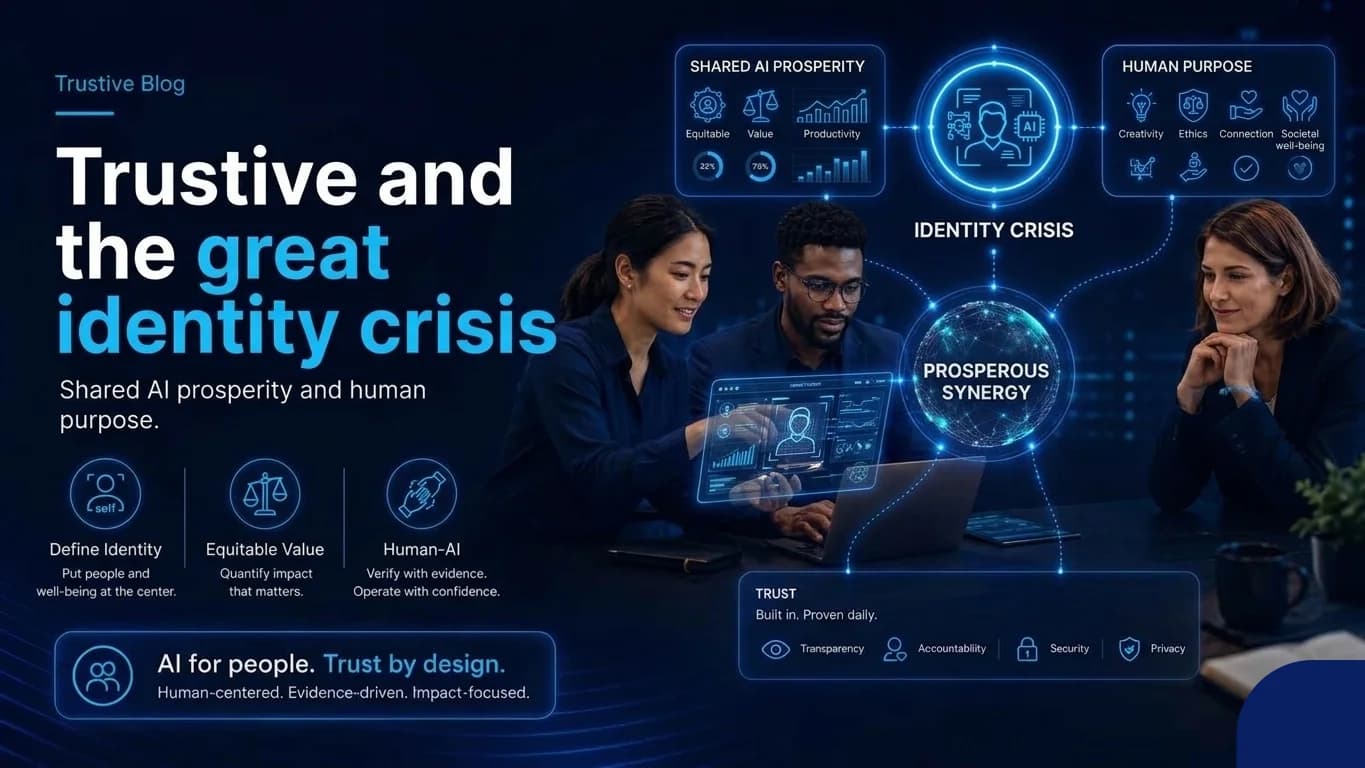
When automation unsettles who we are, income alone is not enough. How Trustive's proposed Human Dividend could return a share of verified AI savings to people as protected time, learning, community and transition support — and what it can and cannot credibly promise.
Trustive can address the identity challenge of automation by connecting shared
economic gains with the freedom and support to build a meaningful life. Its
proposed Human Dividend returns part of verified AI savings to people as
protected time, learning, community contribution and transition support. [1]
The deeper question is what happens when work stops being a reliable answer to
"Who am I?" A person may lose income, but also a familiar role, recognition and
a place to belong. A society that becomes more productive needs ways for people
to remain secure, connected and able to shape their own future.
## A response that reaches beyond the pay cheque
An automation dividend shares the gains from technology. Universal basic income
can provide an unconditional income floor. A national productivity fund could
finance benefits across society. Trustive could contribute evidence about
productivity gains and benefit delivery, while employers and community
institutions create real opportunities to learn, care, mentor and participate.
These functions support different needs. Reliable income makes choices possible.
Protected time makes room for those choices. Relationships, worthwhile activities
and personal agency can help people experience purpose. Human dignity remains
unconditional, including when someone cannot work or does not yet know what comes
next.
What Trustive can credibly promise
Trustive v7 describes a proposed protocol, not a proven solution to loss of
identity. National funds, UBI integration and community programmes are extensions
requiring public decisions, sustainable funding and delivery partners. The
credible ambition is to improve the conditions in which people can recover or
develop purpose; no platform can assign that purpose or guarantee it. [1]
Why automation can unsettle identity
For many people, a job supplies income alongside routine, social contact, a sense
of competence and recognition. When familiar tasks become automated, a person can
remain employed yet feel that their contribution matters less. When a role
disappears, several sources of stability may disappear together. The phrase
"great identity crisis" captures this risk; it is not a diagnosis or a prediction
that everyone will experience the same loss.
The scale of change warrants preparation without assuming that work will vanish.
The ILO and NASK estimated in 2025 that one quarter of global employment lies in
occupations with some generative AI exposure. They identified job transformation
as the more likely overall outcome because many tasks still require human input.
Exposure measures potential task change, not the number of jobs that will be lost. [4]
The connection between trust and belonging
SAP reports that actively disconnected employees are 3.1 times more likely to say
their employer has broken its promises and put in 16% less effort than their
peers. These are associations, not proof that an AI dividend reverses
disconnection. SAP also emphasizes the psychological contract: employers need to
follow through on fair treatment, support and basic needs. Trustive applies that
insight by making a share of AI gains an explicit commitment with evidence of
delivery. [2, 3]
The human needs beneath the job title
Ryan and Deci identify autonomy, competence and relatedness as basic psychological
needs. In everyday terms, people need meaningful choice, opportunities to develop
and use their abilities, and connection with others. Trustive can use these needs
as design criteria when deciding what benefits and programmes to support. [5]
Martela and Steger distinguish coherence, purpose and significance: understanding
one's life, having direction, and feeling that life matters. This distinction
helps explain why replacing lost income may leave other needs unresolved. It also
prevents us from treating purpose as a single score or a job placement statistic. [6]
Identity can grow beyond paid employment
A person can be a parent, friend, caregiver, learner, neighbour, artist or mentor,
as well as a worker. These identities already matter. Trustive should help people
gain the time and practical support to live them. Rest, recovery and receiving
care also belong in a human life; nobody should have to accumulate contribution
records to deserve respect.
The automation dividend in practice
An automation dividend is a deliberate share of productivity gains returned to
people. It can take the form of time, services or money, depending on the
programme and its funding. Trustive's Human Dividend is a proposed way to connect
that principle to measured AI savings and actual benefit delivery. [1]
How the Trustive commitment works
Agree the rules before measurement. The organization defines the workflow,
credible baseline, quality requirements, beneficiaries and benefit share. Worker
representation and a route to challenge decisions help make those rules legitimate.
Verify genuine savings. Measurement accounts for human effort, review and
rework. Independent verification checks the evidence and quality. Inflated
estimates or savings that depend on poorer outcomes cannot justify issuing benefits.
Allocate and deliver the human share. Trustive's proposed T-Cert levels use
minimum shares of 20%, 30% or 40% of accepted savings. Employers must make time
usable and fund any cash obligations. A recorded entitlement is followed through to
delivery, with complaints and disputes visible in the assurance outcome. [1, pp. 17, 20–21]
A simple employer example
Assume 100 employees collectively generate 1,000 verified saved hours in a month
and the agreed human share is 30%. The following is an illustration, not a forecast
or a Trustive pilot result.
Allocation
Hours in the month
Accepted AI savings
1,000
Human benefit pool at 30%
300
Capacity retained by the organization
700
The human pool is equivalent to three hours per employee on average. Its actual
distribution follows the agreed policy and could include protected personal time,
learning and social contribution. Targets and staffing must allow people to use the
allocation; adding equivalent unpaid work later would undermine the commitment.
Saved time creates capacity, not automatic cash. Training fees and transition
support need a separately funded budget. The same saving cannot be counted twice as
both time returned and an independently created cash benefit. Trustive's proposed
accounting explicitly separates these obligations. [1, p. 17]
Universal basic income and shared prosperity
Universal basic income, or UBI, is regular cash paid to individuals throughout an
eligible population without a means test or work requirement. A worker benefit
linked to verified employer savings has a different purpose and eligibility basis.
Trustive's Human Dividend should therefore be understood as a complement to a
public income floor. [7]
UBI can give people room to refuse unsuitable work, care for family or explore a
new direction. It can also support meaningful activity directly. Finland's
2017–2018 experiment with 2,000 unemployed people found better reported life
satisfaction and economic security, with small employment effects whose
interpretation was complicated by another policy change. The trial was not a full
population UBI programme and did not establish a universal solution to loss of
purpose. [8]
Mechanism
Primary function
Who it reaches
Universal basic income
A regular unconditional cash floor
Everyone within the defined eligible population
Trustive Human Dividend
An agreed share of verified AI gains
Beneficiaries of a participating programme
National productivity fund
Finance and sustain public benefits
People and programmes set by public policy
Purpose and community programmes
Relationships and chosen opportunities
People who choose to participate
How the mechanisms can work together
A public income floor addresses security beyond a single employer. A Trustive
programme can add protected time, learning and funded transition support. Community
institutions can offer activities and relationships that people find worthwhile.
Income creates options; accessible opportunities help make those options real.
This wider approach also reaches a weakness in employer-only schemes. People without
a participating employer, including unpaid caregivers and those already displaced,
may receive no direct productivity share. Public provision can extend benefits
beyond the workers whose savings are easiest to measure.
For a payment to remain UBI, its receipt cannot depend on volunteering, completing a
course, holding TRSIV or earning a purpose score. Additional programme grants may
have clear conditions, but a person's basic security and dignity should never depend
on demonstrating usefulness. Funding, eligibility and interactions with existing
benefits require public policy decisions. [7]
National productivity funds and the public dividend
A national productivity fund could give society a financial stake in technological
progress. It would collect authorized cash revenues or hold public investments and
use an approved spending rule to support income security, learning, transition
assistance and community services. This is a proposed policy extension, not an
existing Trustive fund.
Where the money could come from
Possible sources include public investment returns, legislated allocations from
corporate or capital income revenues, and contractual contributions from
participating organizations. Governments could also appropriate demonstrable cash
savings from public services. Each source requires its own authority and accounting;
time saved by a public employee does not itself create spendable revenue.
The IMF argues for stronger social protection, investment in skills and tax policies
that distribute AI gains more broadly. Its analysis supports a public financing
discussion; it does not validate this proposed Trustive fund or a particular levy.
The IMF also cautions against a dedicated tax on AI that could distort investment. [9]
What Trustive would contribute
Trustive could provide evidence about registered productivity claims, agreed
contributions and delivered benefits. Public authorities would retain responsibility
for taxation, eligibility, payments and oversight. A workflow result could inform a
funding agreement, but would not establish national productivity growth or a taxable
profit by itself.
Fund governance should publish actual receipts, investment costs, spending rules and
audited distributions. An independent board with public and worker representation
should oversee conflicts, appeals and long-term reserves. Coverage decisions should
make clear how people outside formal employment and different residency groups are
treated.
Why the funding scale matters
Suppose a fund has AED 1 billion of genuinely spendable resources for a year.
Allocating 60% to equal payments for one million eligible people produces AED 600
per person per year, or AED 50 per month. The remaining 40% could support services
and reserves. These illustrative figures show why a dividend can supplement income
well before it can finance an adequate UBI.
Alaska's Permanent Fund offers a useful institutional analogy: it preserves part of
resource wealth through a public investment fund. Its resource base differs from AI
productivity, so it demonstrates a governance model rather than a ready-made funding
formula. Trustive would need real revenues, enforceable contributions and credible
administration to support any comparable public dividend. [10]
A reason to matter and the freedom to choose
A reason to matter often develops through relationships and activities that a person
values: raising a child, restoring a local place, mastering a craft or helping
someone learn. Trustive can support the conditions for these experiences. The
meaning remains the person's own.
The proposed benefit components create several ways to act on this principle. Their
effects on purpose and belonging are hypotheses to test, not established outcomes of
the protocol. [1, 5, 6]
Trustive component
Practical support
Potential human benefit
T-Time
Protected time or agreed workload reduction
Choice over a larger part of daily life
T-Learning
Learning time and funded courses
Skills, confidence and a new direction
T-Social
Support and records for agreed care or community activity
Connection and recognized contribution
T-Bridge
Funded support through workforce transition
Continuity and room to rebuild
T-Cert
Evidence of scoped commitments and delivery
Confidence that an employer follows through
Build opportunities around real human relationships
An extension of Trustive could partner with libraries, schools, training providers,
care organizations and community groups. People could choose recurring mentoring,
accessible courses, local projects or supported career exploration. Named
coordinators, regular meeting times, transport and care support can make
participation practical. These services would require funded partners; a digital
credential alone cannot provide them.
A programme should respond to real needs identified by its participants and community
partners. Unpaid volunteering must remain voluntary and must not become a route to
replacing paid staff. People should also be able to choose private family life, rest
or recovery without having to turn that time into a public achievement.
Recognition without ranking human worth
Trustive's proposed T-records are non-transferable benefit or contribution records,
with personal details kept private and selectively disclosed. Recognition should
never become a league table of good citizens. Basic support must remain accessible
to people with disabilities, caring responsibilities or limited digital access,
including those who cannot participate in recorded activities. [1, p. 20]
A human journey through AI-driven change
Consider Farah, an experienced operations coordinator whose scheduling and reporting
tasks become partly automated. Her concern is larger than the next pay cheque. She
has built an identity around being reliable and knowledgeable, and she wonders
whether people will still need her. This is an illustrative scenario, not a reported
participant experience.
While the role is changing
Her employer agrees a Trustive benefit policy before introducing the new workflow.
Verified savings support protected time and learning. Farah chooses training in
supplier relationship management and uses some of her returned time to support a
family member. Her workload is adjusted so these choices are usable. She participates
in decisions about the tasks she will retain and develop.
That experience could help Farah see AI adoption as a change in which she has a
stake. She receives evidence that her employer's promise has been honoured, and she
has room to explore another source of professional competence. The employer can
retain her knowledge while benefiting from the remaining productivity gains.
If the role is removed
T-Bridge would need to provide the support agreed in the funded programme, alongside
applicable public protections and employment rights. Farah should receive a clear
explanation of the support, its duration and how to appeal a decision. A proposed
national fund could finance additional provision if publicly authorized; UBI would be
available only if such a policy were actually adopted.
A transition adviser could help her choose between redeployment, further education, a
new business or a period focused on family. If she wants community involvement, a
partner organization could offer a real mentoring role with training and continuing
relationships. Participation would be her choice, with no reduction in an
unconditional income floor if she declined.
What a successful outcome would look like
Success would include adequate support, benefits actually received, and Farah having
greater control over what comes next. A new job may be one outcome. A combination of
paid work, caregiving and learning may be another. Counting course registrations or
issuing credentials would not establish that she feels secure, connected or
purposeful.
Farah may still feel loss or uncertainty. Human support must remain available without
treating that experience as programme failure by the individual. Trustive's
contribution would be practical: keep commitments visible, preserve opportunities and
support continuity while she rebuilds a life that makes sense to her.
Turning the promise into accountable practice
Trustive can only make a credible contribution if its promises survive contact with
daily life. Protected time must remain protected. Learning must be accessible.
Transition assistance must have usable funding. People need confidential complaints,
independent review and a clear remedy when delivery fails. [1]
T-Cert is proposed as a time-limited assurance credential for a specified
organization, workflow and measurement period. It should reflect funding and delivery
evidence and allow suspension when requirements fail. A claim about one workflow must
not become a claim that every aspect of an employer is human friendly. [1, p. 21]
ISO/IEC 42001 provides requirements for an organizational AI management system.
Trustive's proposed alignment can support governance evidence, but T-Cert and
ISO/IEC 42001 certification are separate. Neither a blockchain entry nor an AI
assessment establishes a person's wellbeing or human worth. [1, 11]
Evaluate human outcomes alongside productivity
A recommended pilot would compare a phased rollout with comparable teams where
feasible, measure conditions before implementation, and review results after three
and six months. Independent evaluation should distinguish programme effects from
wider changes and publish adverse results as well as gains.
What to evaluate
Evidence that would matter
Delivery
Time actually taken, workload after allocation, funded support received and unresolved complaints
Security and access
Perceived financial security and participation barriers, including outcomes for people with care or disability needs
Agency and belonging
Voluntary, confidential measures of choice, connection, meaning and trust
Quality and sustainability
Work quality, rework, full programme costs and the reliability of future funding
Personal wellbeing responses should remain voluntary and separate from decisions
about pay, benefits and employability. Aggregated findings can guide improvements
without producing individual purpose scores. Low participation should prompt
investigation of access and relevance rather than pressure to comply.
Who you are when a familiar purpose disappears
You remain a person whose life has value. Losing a role can unsettle identity, but it
does not erase relationships, experience or the possibility of a different future.
Trustive's strongest answer is to return some of technology's gains as the security,
time and support people need to shape that future themselves. That is how its Human
Dividend can become a practical contribution to human purpose.